
The CyberMarketingCon
2026 Agenda
Please note that session times and dates may change.
High Level Schedule: When should I arrive?
To experience the whole conference, plan to arrive in the late morning on Sunday, November 15 and leave late afternoon on Wednesday, November 18 (or stay over to Thursday if you would like or are attending our CEO-Founder-Investor Dinner!)
Sunday - 11/15
Sunday will be a day of workshops and our opening night reception! Plan to arrive around in the late morning or early afternoon if you don't want to miss our 3 hands-on workshops, which start at 1pm CT. Opening night reception starts around 7pm CT.
Monday - 11/16
We kickoff with a keynote at 8:45am CT. Sessions, workshops, and networking throughout the day, including our GovCon Summit. We end the day with a group outing!
Tuesday - 11/17
Today we have sessions, workshops, and networking, plus our CyberCMO Summit; the day kicks off at 9am CT. Tonight we will have multiple activities and dinners.
Wednesday - 11/18
Our final keynote will kick off at 9am CT. Today we will have a three-quarters day of sessions, workshops, and our closing remarks end at 3:30pm CT. Founders, CEOs, and Investors may attend our CyberCEO Dinner at 5:30pm CT.
Note on event times
Event times are subject to change and may not reflect the most up-to-date schedule. Please refer to the conference event app VirtualPro for the latest and most accurate times.
Sunday

Registration Desk Open!
Stop by the Registration Desk on the 2nd Floor Foyer and pick up your badge, swag bag, official conference notebook, and official conference t-shirt!
Explore the Expo Hall, the Fun Station, and join one of the workshops that we have set up on Sunday!

Claude Beginner Workshop
Curious about Claude but not quite sure what to do beyond opening a chat and asking it questions? This hands-on beginner workshop is for you.
Designed specifically for cybersecurity marketers at CyberMarketingCon, this session will help you get comfortable using Claude for real marketing work — without requiring any technical or AI expertise.
We’ll cover the basics of how to work with Claude effectively, how to give it the context and direction it needs, and how to start using it across everyday workflows like research, campaign planning, content development, messaging, analysis, and more.
You’ll work through practical examples alongside other cybersecurity marketers and leave with ideas you can put to work immediately.
Bring your laptop and your corporate or personal Claude account. No AI expertise required!
Claude Intermediate Workshop
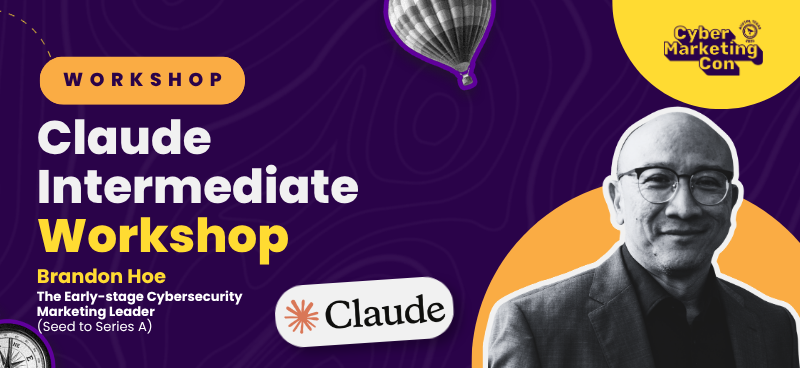
Ready to move beyond one-off chats and start building repeatable AI workflows?
This hands-on workshop is designed for cybersecurity marketers at CyberMarketingCon who already use Claude and want to take the next step: turning the work you do repeatedly into reusable systems.
We’ll focus heavily on Claude Skills—what they are, when to use them, and how to build them around real cybersecurity marketing workflows. We’ll also explore more advanced ways to structure Claude around your work, connect context and resources, and create repeatable processes that can help you and your team work faster and more consistently.
Rather than spending the session perfecting individual prompts, we’ll think bigger: How do you teach Claude how you work once, then reuse that knowledge again and again?
Bring your laptop, your personal or corporate Claude account, and come ready to build!
Points for Creativity: A Roller Derby Workshop for Cybersecurity Marketers
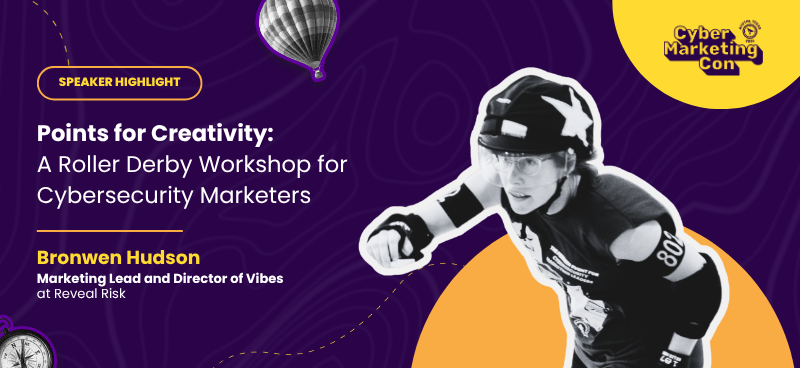
Cybersecurity marketing is defined by constraint: dense jargon, complex concepts, and audiences who demand precision. The challenge isn’t a lack of creativity; it’s finding space to play, experiment, and make ideas feel truly memorable inside those constraints. This workshop is designed as a creative reset for marketers whose brains have been on “perform under pressure” for a little too long… or those who know they are over-relying on AI for tasks that used to feel fun.
Using the bold, irreverent naming culture of roller derby as our playground—think Penelope Bruise, Hermione Danger, Momentum Mori—we’ll explore what happens when you step away from AI and lean back pure sporting instinct. We’ll treat derby naming as a proxy for branding; names must instantly signal identity, tell a mini-story, and provoke a reaction, just like the best campaigns.
The workshop starts with a short individual warm-up to get people out of polished marketing mode and into free thinking. Attendees will quickly jot down the words, frustrations, and ideas that feel most “stuck” or overused in their day-to-day work—terms they’re tired of, value props that feel flat, or product areas that feel impossible to make exciting. This becomes our raw material.
From there, we’ll move into guided prompts such as:* “If this product or problem were a derby skater, what kind of troublemaker would they be?”* “If you could lean into FUD as a joke, what would you really call this thing?”Participants will then work in small teams, remixing their raw material into surprising combinations: pairing technical jargon with unexpected metaphors, fusing emotional states with security concepts, and bending industry clichés until they become something stranger and more interesting. The focus is less on “getting it right” and more on seeing how far they can stretch a concept without compromising accuracy. Teams will, for example: - Take a word from someone else’s list and combine it with their own to create a new character or brand.- Build a “family” of three related derby names that could all be features of the same product. Additional playful constraints will push their creativity further: limiting word counts, forcing a quick pivot from serious to absurd, or asking teams to defend a ridiculous name as if it were going into a boardroom deck. Each round builds on the last, moving from silly and safe to sharper and more deliberate.
As the workshop progresses, teams will converge on a brand concept and tagline born from this chaos—something that still nods to the original cybersecurity idea but now feels alive, specific, and ideally, fun to scream out loud.
Throughout, we’ll surface the meta-lessons: how constraints can unlock creativity instead of shutting it down, and how embracing a bit of discomfort or a “bad idea” often leads to better ones.
Attendees won’t leave with a rigid framework or a perfect campaign. They’ll leave with at least one absurd-but-delightful concept, a renewed sense of creative confidence, and a reminder that even in a jargon-heavy, high-stakes industry, there’s room to play for points.
Workshop: Business Networking Pickup Lines
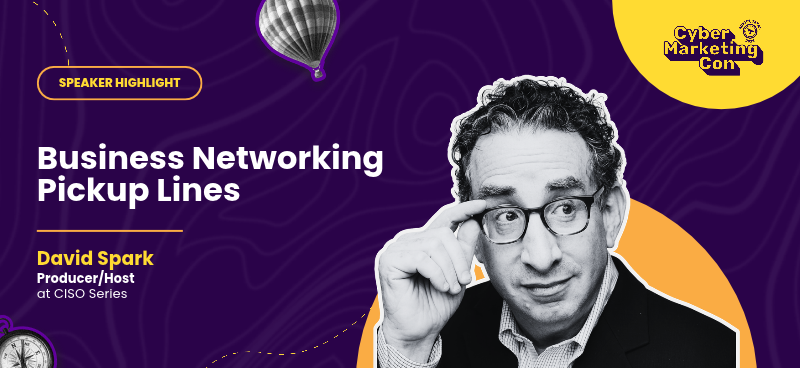
There will be NO NAPPING during this workshop, where everyone will stand up, talk, move around, and learn how to be a professional business “flirt.” We challenge both extroverts and introverts to come to this session and learn how to make in-person cold connections, find *the* person in the room you need to talk to, and qualify someone for a potential business relationship. Check out this video from our workshop at Cyber Marketing Con 2023. If you attended the 2023 workshop, come back again! This brand new workshop is loaded with new exercises.
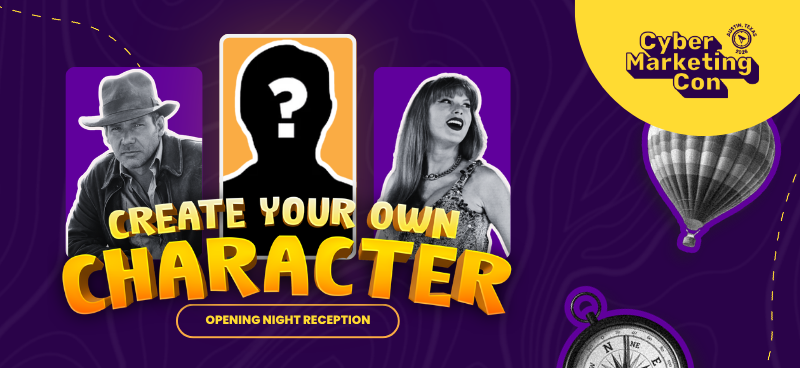
Opening Night Welcome Reception
CyberMarketingCon 2026 Welcome Reception: Choose Your Own Character
Every adventure starts with a character. Who will you be?
We’re kicking off CyberMarketingCon 2026 and our theme, Create Your Own Adventure, by inviting you to dress as your favorite character—from literally anything. Anything!
Here's some ideas: Indiana Jones, a medieval knight, an enterprising elf, Taylor Swift, the CISO at the last company that you sold into, Steve Jobs, Skyrim guards, a boxer, or someone entirely of your own creation.
Go all out or come as yourself (if you’re your own favorite character, that's totally fine)!
Join us to meet fellow adventurers, reconnect with friends, and get the CyberMarketingCon conference started!
Monday
Book Your Complimentary Extras & Activities
Make the most of your CyberMarketingCon experience with these complimentary experiences. Reserve your spot in advance—or stop by to see if a walk-in time is available.
Podcast Studio
Record a podcast, interview, or video in a private, professional studio. Four microphones and an AV technician are included, so all you need to bring is your idea. Walk-ins are welcome when the studio is available.
One-on-One Expert Consultations
Get complimentary, personalized advice from experienced professionals—including cybersecurity industry analysts. Book a session to discuss marketing, channel strategy, graphic design, career strategy, your LinkedIn presence, or the cybersecurity market.
Professional Headshot
Refresh your LinkedIn photo, speaker profile, or professional bio with a polished new headshot. Visit the headshot studio in the Expo Hall, located behind the Fornix Marketing booth. Walk-ins are welcome when space is available.
Fun Station & Postcards
Add some personality to your conference badge with stickers, supplies, and badge ribbons—or write and mail a postcard to someone back home. Stop by the Fun Station in the Expo Hall aka Marketing Land whenever you’re ready for a creative break.
Registration Desk Open!
Stop by the Registration Desk on the 2nd Floor Foyer and pick up your badge, swag bag, official conference notebook, and official conference t-shirt!_x000D_

Complimentary Coffee, Breakfast & Expo Hall (Marketing Land) Open!
Good morning, CyberMarketingCon! Join us at 8:00 AM for complimentary coffee and breakfast, catch up with fellow attendees, and explore the booths in the Expo Hall, aka Marketing Land!
We’ll have a set number of breakfasts ready to welcome you, available first come, first served while supplies last.
There’s plenty to explore: send a postcard from our fun station, drop in for a fresh headshot, catch content on the Expo Hall stage, or settle into a seat for networking and meetings. Come grab a bite and start the day with us!
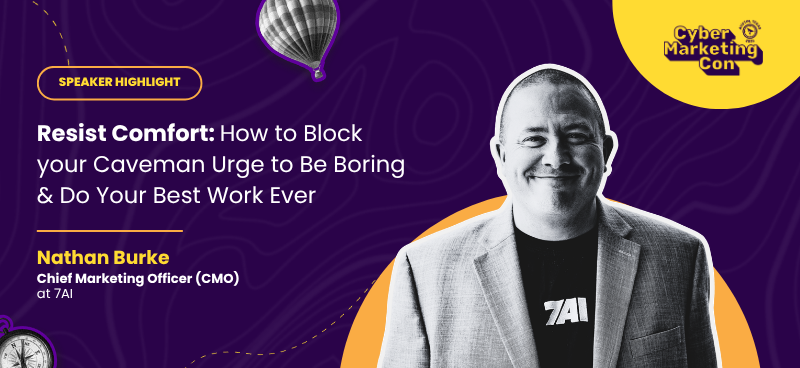
Resist Comfort: How to Block Your Caveman Urge to Be Boring and Do the Best Work of Your Life
As AI makes it easier than ever to create content and campaigns, it's also making it easier than ever to sound exactly like everyone else. The more marketers rely on the same tools, prompts, playbooks, and best practices, the more the market becomes flooded with safe, predictable, and forgettable work.
In this keynote, Nathan Burke makes the bold claim that discomfort is becoming a competitive advantage. That being uncomfortable pushes the boundaries of your work towards what’s actually new, impactful, and worth making.
Drawing from lessons learned building high-growth cybersecurity companies, working within cultures obsessed with continuous improvement, and embracing AI as a force multiplier rather than a crutch, Nathan will explore why complacency is the enemy of great work. He'll share practical ways to seek criticism instead of compliments, challenge conventional thinking, and push beyond the ideas that feel safe.
Virtual Conference - Room 1
Virtual Conference - Room 2
Virtual Conference - Room 3

Nobody Read Your Threat Report. Designing Security Research Practitioners Want to Read
Our industry publishes hundreds of "state of" reports, threat landscapes, and security surveys every year. Practitioners ignore most of them. But there are good news for marketers: The report practitioners actually read, cite, and share is also the one that does the most for your brand and your pipeline. Useful and effective are not opposites. But most security research is just more of the same: Recycled dwell-time stats, leading survey questions, "n=12 CISOs" passed off as data, and a single headline number nobody can map to their own environment.This session is a practical design guide for reports and surveys the practitioner actually wants to read. We'll cover survey design that doesn't generate garbage, metrics that survive a skeptical reader, why segmentation beats a scary average, and how to mine the telemetry you already own instead of running another opinion poll. The goal is produce content practitioners trust — which is the only research that earns the awareness and demand you were after in the first place.
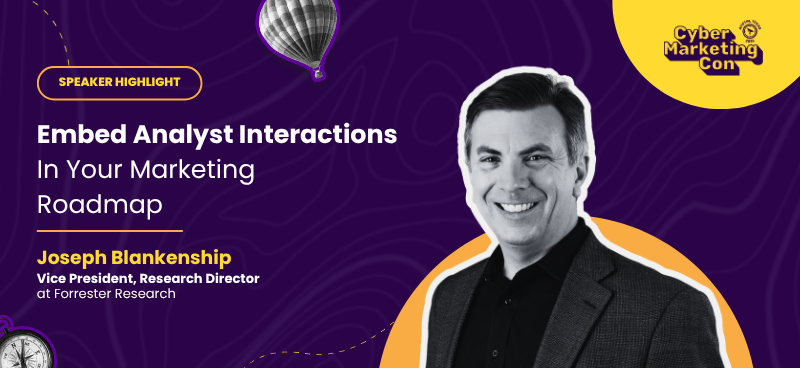
Embed Analyst Interactions In Your Marketing Roadmap
Many marketers view working with industry analysts as a necessary evil and an opportunity to tell them everything about what makes their product or service great. Marketers may only interact with analysts during evaluations, then forget about them until the next one. Getting the most out of industry analysts, however, requires ongoing engagement and listening as much as (or preferably, more than) you speak. Embedding analyst interactions in your marketing roadmap can provide objective third-party insight at crucial points throughout the year. Hear from Recovering Marketer and Forrester VP and Research Director Joseph Blankenship (JB) who was a cybersecurity marketer for 10 years before joining Forrester as an analyst. JB will talk about what worked for him as a marketer, what he sees successful marketers doing as they interact with analysts, and how well-timed analyst interactions can inform your marketing roadmap. Session attendees will learn:•_x0009_Understanding what analysts really do and how they can inform your marketing•_x0009_Creating a playbook for ongoing, successful analyst engagement•_x0009_Embedding analyst interactions to inform your product and messaging launches
Tuesday

We Spent $100K Testing OpenAI Ads so You Don't Have To
By the time I go on stage, our team at AdConversion will have spent $100k+ on OpenAI (ChatGPT) ads across several B2B SaaS brands.
We’ll compress everything we’ve learned into five practical lessons every cybersecurity marketer should understand before launching or scaling on the platform.
You’ll leave knowing how to choose the right conversation themes, determine how specific or broad your targeting should be, and write ads that feel relevant to what the buyer is discussing.

Inside the Cybersecurity Buying Journey: What You Need to Know Going Into 2027
Cybersecurity buying is changing as organizations balance emerging threats, AI adoption, operational resilience, budget pressure and increasing business scrutiny. Drawing on new research from 500 U.S. IT, cybersecurity and business decision-makers, this session explores the priorities shaping cybersecurity investment and what buyers now expect from vendors. Attendees will learn how buying committees are evolving, what drives vendor selection and investment,
and how marketers can engage earlier, reach beyond the CISO and demonstrate measurable business value in 2027.

When Visibility Isn’t Enough: How Cybersecurity Brands Build Trust + Pipeline in an AI-Driven Market
As AI transforms how information is discovered and consumed, buyers - whether synthetic or human - are evaluating more sources, more content, and more voices than ever before.The bar has never been higher.For cybersecurity marketers, this creates a new challenge: visibility alone is no longer enough. The brands winning buyers are building trust through credible voices, third-party validation, data-driven insights, and meaningful engagement with buying teams.
Join Theresa Lanowitz, a leading cybersecurity analyst; Andres Botero, CMO of Horizon3; and cybersecurity GTM expert Annie Matthews for a candid discussion on how innovative security companies are establishing authority, increasing visibility, and accelerating pipeline growth.This can’t-miss panel session brings together analyst, practitioner, and go-to-market perspectives to explore how cybersecurity brands earn credibility with buyers, leverage trusted third-party validation, and translate market influence into measurable business outcomes.

The Human Side of Transformation: Leading Cyber Marketing Teams in the Age of AI & Building AI-Native Marketing Orgs
Cyber marketing leaders are being asked to transform everything at once: team structures, go-to-market motions, executive expectations, and how work gets done with AI. But the hardest part of transformation isn’t the technology. It’s leading people through it.
In this candid panel, cybersecurity CMOs will compare how they’re rethinking their organizations for the AI era—from evolving roles and building AI-native org charts to deciding where AI should create leverage and where human judgment, creativity, and expertise matter more than ever.
Drawing from real-world leadership experience across cybersecurity companies at different stages of growth and transformation, the panelists will dig into the people decisions behind organizational change: supporting early-career talent, creating more leverage across mid-level teams, elevating top performers, introducing new ways of working, and bringing existing teams along rather than simply reorganizing around them.

"Contact Sales” Is Costing You Deals: New Research on Self-Serve Purchasing for Cybersecurity Companies
Your buyer did the research, increasingly through an LLM, and arrives on your site ready to transact. For a growing set of cybersecurity products, a standard purchase doesn’t need a sales call or a demo. Then the path in front of them says “Contact Sales.” That’s where intent stalls. In new benchmark data from 77 cybersecurity companies, 96% say routine transactions are moving to self-serve. Only 21% have a self-serve path at scale.This session digs into that gap. We’ll cover what it costs you to route every purchase through a rep, the deal size buyers will complete with no human involved, and what companies like Tenable and Malwarebytes are doing differently.

INFLU2 Speaking Session
Wednesday

The VC Perspective: Building a Go-to-Market Strategy Worth Investing In
Every go-to-market investment is a bet on how your company will grow. What gives investors confidence that you’re making the right bets—and that your cybersecurity company is ready to scale?
This session explores how venture capital investors evaluate a cybersecurity company’s go-to-market strategy, spending, and performance. We’ll discuss what signals repeatable growth, how expectations change by company stage, and how investors assess decisions about sales and marketing hires, customer acquisition, and expansion.
CEOs and founders will leave with a clearer understanding of how to connect GTM investment to business milestones, explain the tradeoffs behind their plans, and have more productive conversations with their board and investors about what it will take to grow.
Customer & Community Marketers Mixer
Connect with the marketers who turn customers and communities into lasting relationships. Share ideas about advocacy, engagement, retention, customer storytelling, user groups, ambassador programs, and creating spaces where cybersecurity professionals genuinely want to participate.
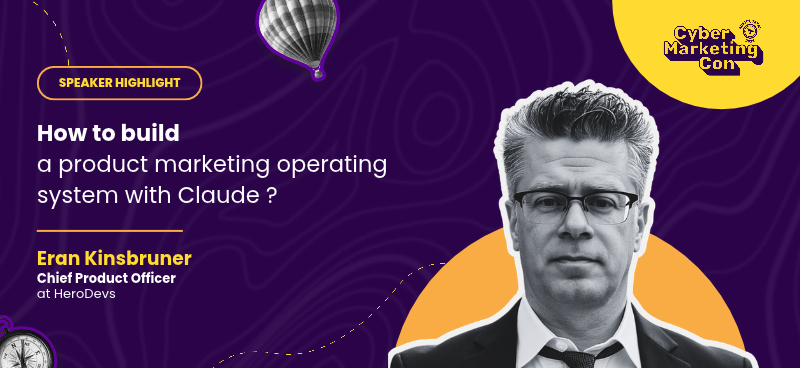
How to build a product marketing operating system with Claude
Marketing new reality is fully dependent on AI - that’s a given. What you do with AI is a different thing, and in this session I would offer a blueprint for product marketers on how to build an efficient working platform all using Claude Code. The session will cover the pillars of the operating system, the skills that are required as minimum to kick such platform and the collaborative tools that can expand such platform across the entire team.

UGC and Community Marketing: Leveraging users to beat the AI content tsunami
Now, with content creation, outreach, and marketing campaigns being fully automated and commoditized by AI, building trust with users and buyers is more difficult than ever before. Authentic communication and social proof are the answers when it comes to making your brand stand out. The core question for marketers is: how can this be scaled?
In the past few years, Hack The Box has attracted a community of over 4 million users. The most interesting part is that most of that growth has been led by the community itself, especially through user-generated content and peer-to-peer recommendations, making it not only a wildly successful but also an extremely cost-efficient growth channel.
In this session, based on my last 2.5 years leading product marketing at Hack The Box, I will share how we’ve leaned on and recruited our own users to be the spokespeople for the brand, not only on the consumer side but also on the business side.
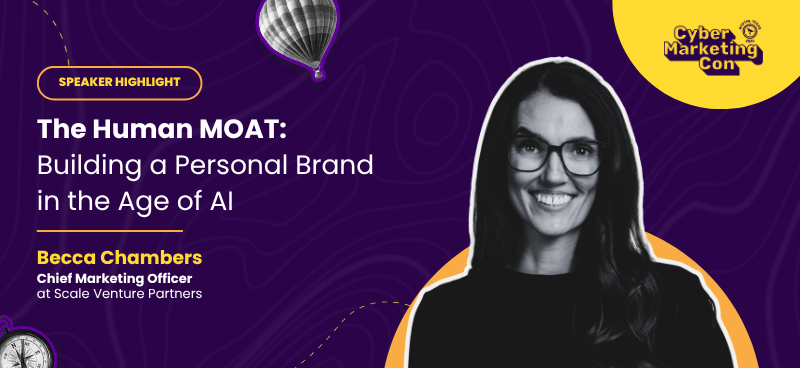
Workshop: The Human MOAT: Building a Personal Brand in the Age of AI
AI has made your personal brand the most important professional asset you have.
Becca Chambers, CMO at Scale Venture Partners and one of LinkedIn's most-followed voices in marketing makes the case for why why your personal brand matters more today than ever before—and what to do to build yours. This session introduces the Human MOAT: a personal branding framework built for the AI era. Based on a foundation of mastery, originality, authenticity, and trust that AI cannot replicate—and the foundation of every individual brand that's cutting through right now.
This session will take you from urgency to execution:* Why the professionals who built their presence before they needed it are the ones winning today* How to identify your content pillars — and the one prompt that unlocks them* What consistency actually looks like when you have a full-time job* How to show up like a human in a feed full of AI-generated everything
You'll leave with a clear read on your own Human MOAT and a concrete plan to start building it.
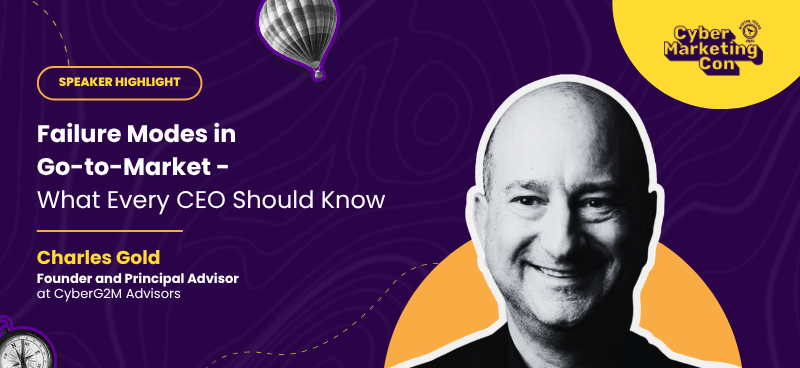
Failure Modes in Go-to-Market -- What Every CEO Should Know
Most go-to-market failures in cybersecurity don't look like failures at first. The numbers get murky. MQLs are up; pipeline isn't. The CRO and the CMO start telling slightly different stories about the same quarter. The board asks for a better marketing plan, and eighteen months later, somebody is "not a fit." The pattern repeats — at venture-backed companies with great products, talented operators, and strong pedigrees. It's almost never the people. It's the system underneath them. And by the time the CEO sees the symptoms, the drag is already compounding.
This session is for early-stage cyber CEOs who suspect the system isn't working but can't yet pinpoint where it's broken. We'll walk through the durable failure modes that show up across stalled go-to-market motions in cybersecurity: fuzzy positioning, an ICP defined by deal momentum rather than buyer fit, messaging that lands flat with sophisticated cyber buyers, the "marketing versus sales" structure that turns every pipeline review into a fight, and the founder reflex to pile on new programs before removing the friction underneath the old ones. No villains required. The patterns are recognizable, durable, and — once named — fixable.
The thesis is simple. In cyber, where buyers are the most sophisticated in enterprise software, weak foundations get punished faster than anywhere else. If positioning is fuzzy, ICP is loose, the message doesn't land, the value prop isn't concrete, or differentiation isn't defensible, you're screwed before you start. No campaign budget compensates for that. And the advice that worked at $5M ARR is wrong at $20M. Stage conditions everything. Most generic G2M frameworks ignore that, which is why so many of them under-perform in cyber.
CEOs will leave this session with a diagnostic checklist for spotting drag before the board does, a framework for telling alignment problems apart from talent problems, and a short list of moves that consistently produce compound growth at this stage.